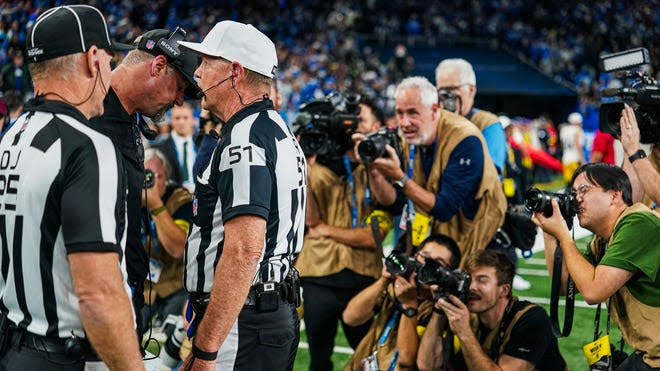
The Detroit Lions’ most recent loss came down to their last drive, with the referees needing to explain a few things down the stretch.
The Lions (8-7, 3rd in NFC North) lost 29-24 to the Pittsburgh Steelers (9-6, 1st in AFC North) on Sunday, Dec. 21 at Ford Field in Detroit. Down by five points with eight seconds left in the contest and needing a touchdown to stay alive, Lions quarterback Jared Goff found receiver Amon-Ra St. Brown for a fourth-down completion near the goal line. St. Brown, about to be tackled before scoring, then lateralled the ball to a surprised Goff, who ran it in for what appeared to be the game-winning touchdown as time expired.
However, after a discussion among the referees that took several minutes to complete, the touchdown was nullified due to an offensive pass interference call on St. Brown, which ended the game in a Steelers’ win.
Here’s how referee Carl Cheffers explained the pass interference call on the game’s final play.
“The official who called the foul said that the receiver created separation that gave him an advantage in catching the pass. So, he called pass interference,” Cheffers said.
Cheffers called the sequence “a pretty complex play” since St. Brown gave up possession of the ball, requiring the referees to determine whether it was a legal lateral (which would have led to a Lions’ touchdown) or a fumble (which would have downed the play at the point of the fumble since there was less than two minutes to go in the game.). Here’s how he explained that call.
“We ruled that it was a backward pass, so the recovering player was able to advance it and that recovering player advanced it for a touchdown. We had to rule on that and then because of the offensive pass interference, it negates the touchdown. Because it is an offensive foul, we do not extend the half. Therefore, there is no score and there is no replay of the down. That’s the way the rule is written,” he said.
For his part, St. Brown neither agreed nor disagreed with the call.
“It is what it is, those are the rules, you can’t change them. But it never comes down to one play, just because of that play” he said. “We had calls go our way, too, throughout that last drive, so it goes both ways.”
St. Brown referred to a defensive pass interference call on a fourth-down incomplete pass attempt from Goff to Jameson Williams that helped extend the drive and a tripping call on linebacker Alex Highsmith as the calls that went the Lions’ way. But it was another pass interference call later in the drive that brought out more controversy.
On first-and-goal from the 1-yard line and 25 seconds left in the game, Goff found St. Brown for what appeared to be the go-ahead touchdown, but the score was negated on a debatable offensive pass interference call on rookie receiver Isaac TeSlaa. Here is what Cheffers had to say about that play:
“The reporting official on that play told me that the offending player picked one of the defenders, creating an opportunity for the offensive player to make the catch,” he said, referring to TeSlaa as the “offending player” and St. Brown as the “offensive player.”
Lions quarterback Jared Goff, who doesn’t often publicly criticize the referees, defended the rookie receiver in this instance.
“The one where [St. Brown] caught it and we thought was a touchdown, in my opinion that’s a bad call,” he said. “But those happen. They have a tough job, they make calls that go our way all the time. But that one in particular, [TeSlaa] shouldn’t hang his head about.”
With the loss, the Lions are essentially out of the NFC playoff picture. And though those two calls don’t excuse the team’s lackluster performance at home against the Steelers, either one of them could have led to a Lions win if they went in the other direction.
Need to catch up on the news during your lunch break? Sign up for our Sports Briefing newsletter to get daily summaries of Detroit sports!
Be the first to comment