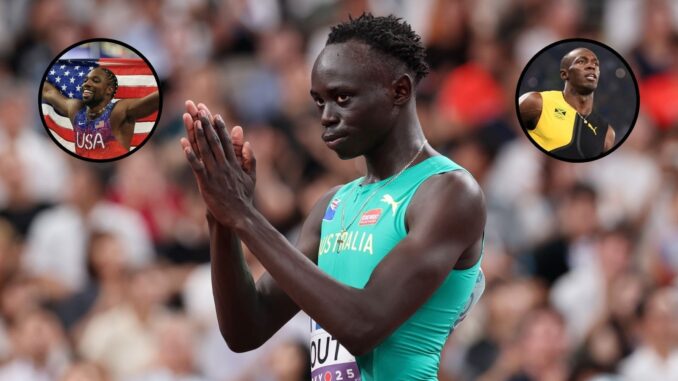
Rising sprint sensation Gout Gout is already being tipped to follow the 100m precedent set by legends such as Usain Bolt and modern-day showman Noah Lyles. The comparisons may seem bold given his youth, but those within athletics circles believe the blueprint for global 100m dominance has already been written – and Gout appears determined to follow it.
The precedent is clear. Bolt, widely regarded as the greatest sprinter in history, did not simply burst onto the scene as a 100m runner. Early in his career, the Jamaican focused heavily on the 200m, where his long stride and upright running style flourished. It was only later that he fully embraced the 100m, going on to redefine the event with his world-record 9.58 seconds and multiple Olympic titles. His transition proved that mastering speed endurance and race mechanics over 200m could create an unstoppable force in the shorter sprint.
Lyles has followed a similar trajectory. Known initially for his dominance in the 200m, the American steadily sharpened his acceleration and top-end speed to become a world champion in the 100m as well. By building confidence and championship experience in the longer sprint, he developed the composure and race intelligence required to excel in the sport’s blue-riband event.
For Gout, the parallels are hard to ignore. Blessed with a tall frame and fluid stride pattern, he possesses many of the physical traits that made Bolt so devastating over both distances. Coaches and analysts have pointed out that his raw speed is matched by an ability to maintain form under pressure – a crucial ingredient for championship sprinting.
What sets apart the Bolt-Lyles pathway is patience. Neither athlete was rushed into 100m stardom. Instead, their development was carefully managed, ensuring they peaked physically and mentally at the right time. For a young sprinter like Gout, this is perhaps the most important lesson of all. The temptation to chase headlines with premature 100m campaigns can derail promising careers. The 200m provides a slightly more forgiving arena to hone race execution, curve running, and finishing strength.
Observers suggest that if Gout continues to develop his drive phase and reaction times, a seamless shift into elite 100m racing could follow. Bolt’s transformation from a promising junior to a global icon was built on refining his start, once considered his weakness. Lyles, too, invested heavily in explosive block work to complement his natural top-end speed. These technical adjustments are often what separate good sprinters from generational talents.
Beyond the stopwatch, there is also the matter of presence. The 100m has always demanded more than just speed. Bolt captivated the world with charisma and confidence, while Lyles has embraced the role of entertainer and ambassador. Early signs suggest Gout has the composure to handle attention, but navigating the spotlight will be as vital as shaving hundredths off his time.
Ultimately, following the precedent set by Bolt and Lyles does not mean copying them. It means understanding the proven formula: dominate the 200m, build endurance and technical mastery, then unleash that power over 100m. If Gout can stay healthy, grounded, and patient, the path to sprinting’s most coveted crown may already be laid before him.
Be the first to comment