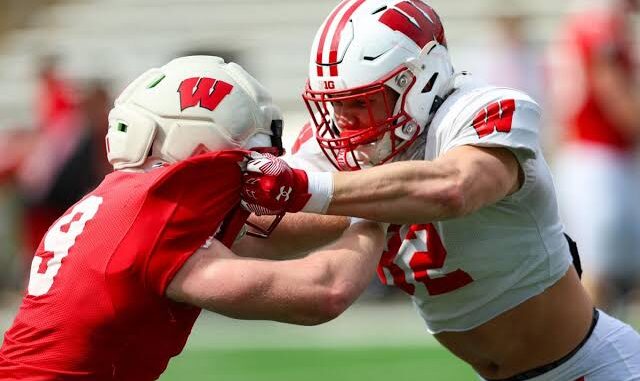
Wisconsin football’s seventh spring practice of 2026 offered another valuable glimpse into how Luke Fickell’s team is progressing as preparations continue for the upcoming season. With several new faces integrated into the roster and major position battles still unfolding, the latest practice highlighted both encouraging developments and areas where the Badgers still have room to improve.
One of the clearest observations from practice was the continued growth of the quarterback room. Transfer quarterback Colton Joseph remains the frontrunner for the starting role and continues to show why Wisconsin targeted him in the portal. His athleticism and mobility add a new dimension to the offense, particularly in designed quarterback runs and bootleg concepts. While his arm talent has been evident throughout spring, coaches are still working with him on consistency and decision-making as he adjusts fully to the system. Backup Deuce Adams also had strong moments, further reinforcing that Wisconsin’s quarterback depth is much improved compared to recent seasons.
The running back room again looked like one of the deepest and most talented groups on the roster. Abu Sama continues to impress with his explosiveness and vision, appearing every bit the feature back Wisconsin hoped for when he transferred in. Darrion Dupree looks healthy and dangerous as a complementary option, while Bryan Jackson and Nate Palmer have flashed enough to suggest the Badgers may have a legitimate four-man rotation in the fall. The competition and versatility in the backfield should allow offensive coordinator Jeff Grimes to be creative with personnel packages.
At wide receiver, the Badgers appear to be making strides after an inconsistent 2025 campaign. Several pass catchers made notable plays during team drills, and the group as a whole appears more explosive than last season. Eugene Hilton continues to emerge as a reliable target, while Tyrell Henry’s speed and route-running make him one of the most dangerous weapons in the offense. The increased confidence in the receiver room is an encouraging sign for an offense looking to become more balanced and dynamic in 2026.
Along the offensive line, experimentation remains ongoing as the coaching staff searches for the best combination. Wisconsin has shuffled players across multiple positions this spring, and that trend continued in practice No. 7. While continuity has not yet been established, the staff appears committed to finding the five players who offer the best blend of toughness, athleticism, and chemistry. The line remains one of the more important storylines of spring because its development will ultimately determine how far the offense can go.
Defensively, the secondary continues to stand out as perhaps the most improved unit on the roster. Transfer additions and returning young players have created fierce competition at cornerback and nickel, with multiple defensive backs making plays on the football throughout practice. The added depth and athleticism in the defensive backfield should help Wisconsin defend the spread-heavy offenses it will face in the Big Ten. Young players such as Cai Bates and Jai’mier Scott have consistently flashed throughout camp.
Perhaps the biggest overall takeaway from Wisconsin’s seventh spring practice is that this remains a team very much in transition—but one with significantly more talent and upside than a year ago. With new transfers, a revamped offensive approach, and increased competition at nearly every position, the Badgers are still ironing out inconsistencies. However, the talent infusion is evident.
If the offensive line solidifies and the quarterback play stabilizes, Wisconsin may finally be positioned to take a meaningful step forward in 2026. Spring practice No. 7 showed a program still developing, but one clearly trending in the right direction.
Be the first to comment