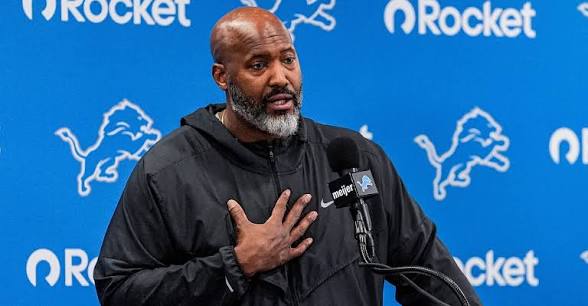
When Brad Holmes addressed the media following the early stages of NFL free agency, one question dominated the conversation: why didn’t the Detroit Lions invest heavily at EDGE rusher? In a market where elite pass rushers commanded massive contracts, the Lions’ relative restraint stood out. Holmes, however, offered a clear and calculated explanation that reflects both the team’s philosophy and its long-term vision.
First and foremost, Holmes emphasized value over urgency. While EDGE is widely regarded as a premium position in today’s NFL, the Lions were unwilling to overpay simply to fill a perceived need. Free agency often inflates player prices, especially at positions like pass rusher where demand consistently outweighs supply. Holmes made it clear that committing significant cap space to a player who may not outperform expectations would be counterproductive to the team’s steady rebuild.
Instead, the Lions are leaning on internal development. Over the past few seasons, Detroit has invested heavily in young defensive talent through the draft. Players like Aidan Hutchinson have already emerged as foundational pieces, and the organization believes others within the system can take meaningful steps forward. Holmes pointed out that growth from within is not only more sustainable financially but also helps maintain continuity in the locker room and coaching schemes.
Another key factor in the Lions’ approach is roster balance. Holmes stressed that building a competitive team isn’t about winning headlines in March—it’s about constructing a well-rounded roster capable of sustained success. Allocating too much money to one position group can create weaknesses elsewhere. By avoiding a blockbuster EDGE signing, the Lions preserved flexibility to address other areas of need, including depth across both sides of the ball.
Holmes also hinted at confidence in the coaching staff’s ability to maximize talent. Under head coach Dan Campbell and defensive coordinator Aaron Glenn, the Lions have developed a reputation for getting the most out of their players. Rather than relying on a single high-priced star, Detroit is aiming to generate pressure through scheme, rotation, and collective effort. This approach aligns with the team’s identity—tough, disciplined, and unselfish.
Financial discipline played a significant role as well. The Lions are entering a crucial phase where extensions for core players will soon become a priority. By avoiding major free-agent splurges now, Holmes ensures the team retains the flexibility to reward its homegrown stars in the future. This forward-thinking strategy is essential for maintaining competitiveness over multiple seasons rather than chasing short-term gains.
It’s also worth noting that Holmes didn’t entirely rule out adding to the EDGE position. Instead, he suggested that the team would explore alternative avenues, such as the NFL Draft or more modest free-agent deals. The draft, in particular, offers a cost-effective way to acquire high-upside talent, and the Lions have demonstrated a strong track record in player evaluation in recent years.
Ultimately, Holmes’ message was one of patience and conviction. The Lions are no longer in a phase where they need to make desperate moves to accelerate progress. Instead, they are building deliberately, trusting their process, and prioritizing long-term success over immediate splash.
While some fans may have hoped for a marquee EDGE signing, Holmes’ explanation underscores a broader philosophy—one rooted in discipline, development, and sustainable growth. If the Lions’ recent trajectory is any indication, that approach may prove far more valuable than any single free-agent acquisition.
Be the first to comment