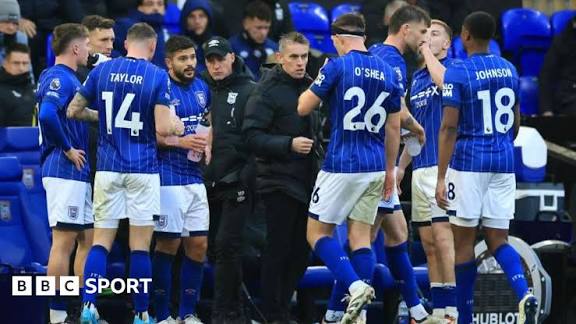
When Kieran McKenna walked through the doors at Portman Road in December 2021, Ipswich Town were drifting in League One and desperately searching for direction. Three years on, the landscape looks entirely different. Promotion to the Championship, a push toward the Premier League, and a clear footballing identity have transformed the club’s trajectory. Central to that evolution has been recruitment. With 51 signings made during McKenna’s tenure, the question naturally arises: have they been more hits than misses?
The short answer leans firmly toward success.
Recruitment under McKenna has not been about headline splashes but about profile, personality and tactical fit. Players such as Leif Davis, Nathan Broadhead and Conor Chaplin have embodied that approach. Signed for modest fees or on smart deals, they have become central figures in Ipswich’s rise. Davis, in particular, has redefined the left-back role with his attacking output, while Chaplin’s versatility and goals have made him indispensable. These are not merely decent acquisitions; they are transformational ones.
Then there are the experienced heads brought in to stabilise and elevate standards. Sam Morsy’s leadership, though initially secured before McKenna’s arrival, has been maximised under his management. Additions like George Hirst and Axel Tuanzebe have strengthened key areas at crucial moments. The strategy has often blended youth with know-how, ensuring the squad evolved without losing balance.
Of course, 51 signings inevitably include some that failed to ignite. A handful struggled for game time or consistency, while others were moved on quietly after short spells. That is the nature of modern squad-building, especially across different divisions. The jump from League One to the Championship demands recalibration, and not every player signed for one level can thrive at the next. Yet what stands out is the relatively low number of outright failures.
A significant factor behind the positive hit rate has been alignment. Ipswich’s recruitment team and McKenna appear unified in vision. The players brought in typically fit a defined style: energetic, tactically intelligent, technically secure and hungry to improve. Rather than chasing reputations, the club has targeted profiles that suit a possession-based, high-intensity system. That clarity reduces risk.
Another marker of success is asset growth. Several signings have seen their market value increase substantially. Young players have developed rapidly under McKenna’s coaching, turning shrewd investments into prized assets. In the modern game, that progression matters as much as immediate performance.
Depth signings have also played a subtle but important role. While not all 51 were regular starters, many contributed in cup competitions, during injury crises or in periods of fixture congestion. Championship campaigns are long and unforgiving; squad rotation is not a luxury but a necessity. The ability to rely on squad players without a dramatic drop in performance suggests recruitment has been largely on point.
Ultimately, judging 51 signings purely as hits or misses oversimplifies a nuanced process. Some were stepping stones, some were developmental projects, and some were long-term pillars. However, when measured against results — promotion, sustained competitiveness and a strengthened squad core — the balance tilts decisively toward “hits.”
No recruitment record is flawless. But in transforming Ipswich Town from mid-table League One uncertainty to a club knocking on the Premier League door, McKenna and his recruitment team have built far more successes than setbacks. In the grand tally of 51, the overwhelming majority have pushed Ipswich forward — and that is the clearest verdict of all.
Be the first to comment