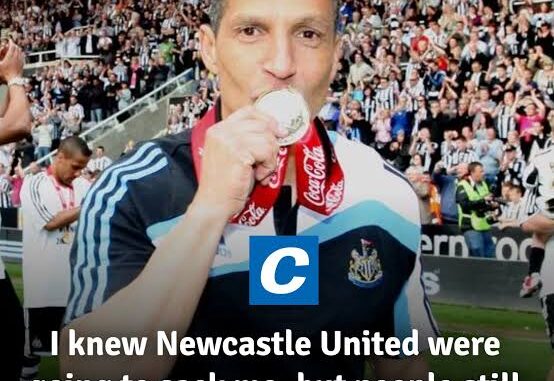
Former Newcastle United manager Chris Hughton celebrates his side secured promotion to the Premier League in 2010
Former Newcastle United manager Chris Hughton celebrates his side secured promotion to the Premier League in 2010 after beating Ipswich Town
Chris Hughton was only at Newcastle United for less than three years, but experienced just about every high and low during a turbulent time on Tyneside.
Throughout his brief but memorable spell at St James’ Park, he was a hugely influential and calming influence as the club navigated choppy waters, and he departed with the first team in a much healthier position.
From an out-of-the-blue phone call from Kevin Keegan which paved the way for his arrival at United, to leading the side back to the Premier League in 2010, Hughton saw it all, and became something of a cult hero among the Newcastle fanbase.
He worked under three managers, including United legends Keegan and Alan Shearer before finally taking the helm in strange circumstances under then owner Mike Ashley, but will always be remembered for helping to galvanise the team after relegation, and of course that 5-1 derby-day victory over Sunderland.
His move to Tyneside was something of a surprise for the former Tottenham Hotspur and Republic of Ireland defender, and something of a whirlwind change – but it wouldn’t be the first time events unravelled quickly.
“I left Tottenham in December, and I got a call in February with Kevin Keegan on the phone saying “Chris, how are you? Would you fancy coming up to Newcastle?” Hughton said, reflecting on his dramatic United career. “That was it. I was up the next day, working with the first team.
Article continues below
“First of all, I thought is this somebody winding me up? I had played against Kevin and I knew him, but not that well. I was surprised because there was no warning that Kevin’s going to ring.
“I was up the next day and with Kevin, the things that I’d heard about him, are exactly true. He’s a great fella and had a really good relationship with the players. He could be winding them up during the week, or playing five-a-side with them during the week and giving them a bollocking on a Saturday.
“He had such an aura about him, such respect, particularly with the senior players. He was really great to work with and for the rest of that season, we were very competitive in that division. Unfortunately, then it fell apart for Kevin and he resigned.
“Then we had a period when Joe Kinnear came in – which was really just to steady the ship. For a period of time, he did well.
“I’m thinking about him now, as we always do, particularly the fact he’s not with us anymore. He had a heart attack at a game at West Brom that morning, in the hotel. Then there was a period of time when the club weren’t quite sure what they were going to do.
“Then, of course, Alan Shearer came in for those last six games of the season and the team got relegated. I was then caretaker again for the summer period, right the way through pre-season. I started well and then they gave me the job – I absolutely loved it.”
Alan Shearer with assistant manager Iain Dowie and first team coach Chris Hughton
Alan Shearer with assistant manager Iain Dowie and first team coach Chris Hughton in 2009
That summer was a hugely difficult one for Newcastle, although they were able to keep a core of the squad which had suffered relegation.
However, a now famous pre-season defeat at Leyton Orient brought the group together and focused the squad on the job ahead of the – namely to take United back to the Premier League.
“We’d had a summer where it was really determined the ones that were going to stay and the ones that weren’t,” Hughton added. “This was where player power in that group as a team showed.
“We had done OK in pre-season, but a lot of Newcastle supporters will remember we lost 6-1 at Leyton Orient. The players themselves had a meeting and what came out of that meeting was that it determined who are the ones that want to stay for the fight and the ones that didn’t. Steve Harper, who was my keeper at the time, was instrumental in it.
“We had a core of so many strong personalities, like Kevin Nolan, who was my captain, so although I’m saying Steve Harper, it would have very much been a group effort. From that moment, it was all uphill.
“When you’ve got a group of that quality, when you’re winning games, it looks after itself. I felt that to manage that group of players, that all the experience that I’d had over 14/15 years as an assistant manager – getting close to players, working, problem solving – had set me up well.”
That season turned into a memorable for the Magpies, with the Championship title sealed in style as United brushed aside all competition.
Newcastle United player Kevin Nolan (2nd right) celebrates with manager Chris Hughton on April
Newcastle United’s player Kevin Nolan celebrates with Chris Hughton in April, 2010(Image: Stu Forster/Getty Images)
Stars such as Kevin Nolan, Joey Barton and Andy Carroll flourished, with the trophy paraded at St James’ Park in emotional scenes for Hughton.
The Essex-born boss had spent his entire playing and coaching career in and around London, but he became an adopted Geordie after leading the side back to the top flight.
Not that it was all plain-sailing. Dealing with a squad of big personalities brought its own challenges, which he dealt with in his own style.
“Newcastle was my first managerial role,” he said. “Not only just managing the club but living up in the area and it was fabulous.
“I’ve heard a lot of coaches and chairman speak about the difference to being a struggling team in the Premier League or being a successful team in the Championship – where you’re having so many good days, so many wins, so many good feelings and so many good weekends.
“Although there were some problems, because when you’ve got a group like I had with the strong characters that I had, you’ve got to manage them all.
“I can remember where we’d had one incident, which we all had to deal with. Something had leaked out and I can remember one press conference where they were trying to get this information out of me.
“I had to deal with the press and remember all of those 15 years before, I hadn’t had to deal with them. In the end, three or four of the reporters kept looking at this other reporter and saying, ‘why don’t you just leave him?’ They knew you’re not going to get it out of him.
“This was an incident that had happened that, as a coach and a manager, you’re trying to keep quiet. I was hoping that somebody would have released that in one of their books, but they never did, so I won’t share. It was a big education for me though, particularly dealing with the press. You’ve got two daily papers up there that are all Newcastle and Sunderland. It was a great learning curve.”
Chris Hughton speaks to Newcastle United owner Mike Ashley and managing director Derek Llambias during a training session in November, 2009
Chris Hughton speaks to Newcastle United owner Mike Ashley and managing director Derek Llambias during a training session in 2009
Despite promotion success and a positive start to their first season back in the Premier League – United beat Aston Villa 6-0 and rivals Sunderland 5-1 in the first few months of the 2010-11 campaign – Hughton felt the writing was on the wall before he was finally sacked.
“We had a very good start at Newcastle,” he said. “Mike Ashley was chairman, and my contract was up at the end of the season – but negotiations were very, very slow. I quickly determined that once results weren’t going our way he was going to make a change.
“We were 10th in the league up until I was sacked, despite a good start. It was a team that had gone down and then come back up again, so we had teething problems. We hadn’t done much in the summer going into that Premier League season but with that group of players, it could go either way, and we were somewhere in the middle – we were 10th in the division.
“I didn’t see Mike a lot. Mike came down to the training ground every now and again. Even as we speak now, in modern-day management, the most important combinations that you can have and relationships that you can have is with the chairman.
“Although, most of the day-to-day conversation would have been with Derek Lambias, who was the CEO at the time, and very much Mike’s right-hand man.
“We had been at a stage where the contract talks had stalled so much that we hadn’t even had so many contract meetings. The gaps in between were so big.
“I was conscious that he could get it done if he wanted to, because even at that stage, I had lost Colin Calderwood, who was my assistant. I remember Colin had been offered the job at Hibernian as manager, and he didn’t want to leave me. I said, Colin, take it because I don’t know how long I’m going to be here.
“For that last period of my time there, my assistant was Paul Barron – who was my goalkeeping coach. The writing was on the wall. I knew that as soon as we had a little bit of a dip, then potentially I would be gone.
Article continues below
“There was no drop-off in the players. The players were still 100%. Still, to this day, I have so many Newcastle supporters coming up to me saying thank you for the job.”
Chris Hughton was speaking on The Managers podcast, powered by BOYLE Sports – Home of the Early Payout. Listen via Spotify and Apple Music now.
Be the first to comment