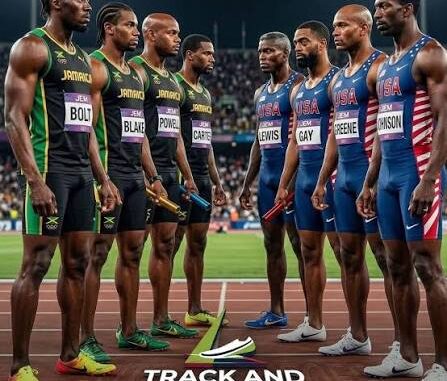
Few events in track and field generate as much anticipation and raw adrenaline as the men’s 4x100m relay. When Team Jamaica and Team USA step onto the track, it’s never just a race—it’s a clash of sprinting cultures, legacy, and execution under pressure. On paper, both nations are stacked with world-class speed, but the relay is rarely decided on paper alone.
Team Jamaica’s identity in the 4x100m has long been built on explosive individual brilliance combined with surprisingly smooth baton exchanges. The legacy of icons like Usain Bolt still looms large, not just because of his unmatched speed but because of how Jamaica mastered the art of running as a unit during their golden era. Even in the post-Bolt generation, Jamaica continues to produce elite sprinters capable of running sub-10 seconds. Their strength lies in rhythm—when they get their exchanges right, they flow like a single organism.
However, Jamaica’s Achilles heel has occasionally been inconsistency in baton passing under pressure. A slight mistiming or a dropped baton can instantly erase even the fastest lineup. That said, when they execute cleanly, few teams in history have looked as dominant over 100 meters per leg.
On the other side, Team USA arguably brings the deepest pool of sprint talent in the world. With a conveyor belt of athletes capable of running blistering times, the U.S. often fields a lineup where every leg is a threat. Names like Christian Coleman, Trayvon Bromell, and Noah Lyles represent not just speed but experience at the highest level.
Yet, for all their depth, Team USA’s relay history has been plagued by one recurring issue: baton exchanges. Over the years, disqualifications and messy handoffs have cost them medals on the biggest stages, from the Olympics to World Championships. It’s not a lack of speed—it’s a lack of cohesion in the most critical moments. When the U.S. gets it right, though, they are nearly unbeatable, often posting some of the fastest relay times ever recorded.
So, who takes gold?
It ultimately comes down to execution over four seamless exchanges. Jamaica tends to rely on chemistry and rhythm, often sticking with more consistent relay squads. The USA, meanwhile, may rotate based on form, sometimes sacrificing familiarity for raw speed. That difference in philosophy can decide everything in a race that lasts under 38 seconds.
If both teams run perfect races, the edge slightly leans toward Team USA due to sheer depth and the ability to stack elite sprinters on every leg. But perfection is rare in the 4x100m. History suggests that the team with cleaner baton exchanges usually wins—and in that department, Jamaica has often looked more composed when it matters most.
In the end, this matchup is too close to call with absolute certainty. It’s a battle of precision versus power, rhythm versus raw speed. One sloppy exchange, one mistimed step, and the gold medal could swing either way.
Be the first to comment