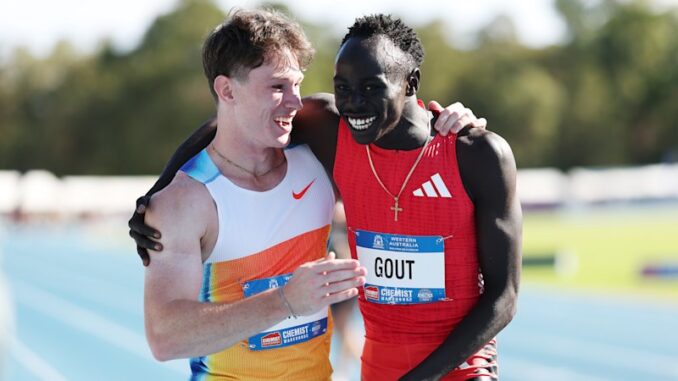
On one of the most dramatic nights in the recent history of Australian athletics, it said plenty about the sport’s growing strength that one of its highest profile stars wasn’t even at the track on Friday night.
Teenage sprint sensation Gout Gout was resting up, ahead of his Australian national championship campaign getting underway on Sunday in the 200m. Gout is set to renew his rivalry with Lachie Kennedy in the half-lap sprint and record times could be in the offing.
But while his face may be on the posters, Gout’s appearance in Sydney is far from the only highlight of a national titles full of world-class talent across distances and disciplines. And with a splash of soap opera and controversy thrown in for good measure.
Fans at the Sydney Olympic Park Athletic Centre were treated to all of the above in a few frantic evening hours on Friday.
Jess Hull sprawled on the ground as Claudia Hollingsworth sprints to the line.
Making the most of warm conditions and a new track, Kennedy first scorched home in 9.96 seconds in heat one of the 100m, becoming the first Australian to break the 10-second barrier on home soil.
Jess Hull’s long-awaited face-off with Claudia Hollingsworth in the 1500m then ended in controversy, when a slow race ended with Hull being tripped by Hollingsworth in the home straight, and the youngster being disqualified. The Tokyo silver medallist limped home last and Sarah Billings went from a probable third to national champion.
Under-appreciated 19-year-old Cam Myers then turned in another powerhouse 1500m, leading from wire-to-wire and registering the fastest time ever run on Australian soil.
It was a 120-minute slice of action that highlighted the growth of depth in Australian athletics over the last five years, and could potentially see the hosts develop into a force in track-and-field at the Brisbane Olympics in 2032.
“We’re in a phenomenal stage – it’s amazing, it really is,” Athletics Australia general manager of high-performance Andrew Faichley said. “I was talking to someone about it today – we’ve had strong periods before, but you come to a national championships and you probably have to wait through a couple of events because they weren’t quite as strong.
“But now … the 100s and 200s, 400 now, 800s are very strong; 1500 we have elite guys and girls. All of our field event athletes have been so successful over a long period. So every event almost, we’ve got someone who’s doing something phenomenal. We’ve not been this strong across so many categories.”
Lachie Kennedy ran the second fastest 100m ever by an Australian on Friday night in Sydney.
The emergence of a new golden era since the Tokyo Olympics in 2021 can be seen in the numbers of athletes not just winning medals but contending for them in finals, which is an elite level.
In the 2016 Games in Rio, Australia won two medals and had 11 finalists in athletics. A year later, it fell to just nine finalists at the World Championships.
Since 2021, however, Australia’s team has won six or more medals, and had 15 or more finalists, at every Olympics or World Championships. In 2024, there were seven medals and 18 finalists. The size of the team qualifying for the major meets has also doubled from 2016.
Indoor world championship results also show the growth. In 2018, Australia had just two finalists and won no medals. Last year it was seven medals and 12 finalists. Last month in Poland it was five medals and nine finalists.
Nicola Olyslagers (right) and Eleanor Patterson took gold and silver at the world indoor championships in 2025.AP
It’s certainly all a far cry from the 2005 World Championships in Helsinki, when Australia won a solitary bronze medal and had just four athletes make finals.
Australia’s field athletes have been the backbone, with stars like Nicola Olyslagers, Nina Kennedy, Kurtis Marschall, Eleanor Patterson, Mackenzie Little and Matt Denny routinely winning medals.
World-class middle-distance runners are now growing on trees, too, and Aussie walkers continue to be a force. But globally competitive sprint talent – a rarity in Australian athletics – is now present, too. Gout and Kennedy have posted record times, Rohan Browning is still fast, and Torrie Lewis has taken down star names. In the 400m, big Reece Holder is also poised for big things.
As a 17-year-old, Gout won the 200m national title last year and later broke Peter Norman’s 56-year-old record by running 20.04s.
Peter Bol is a star middle-distance runner for Australia.Oscar Colman
But after making the semi-finals of the world championships Gout was run out by more seasoned sprinters, and Kennedy has also bested the teenager twice in the last two years in 200m showdown, via big leads in the first 100m.
According to Faichley, it all points to the untapped potential still left in Gout.
“He’s going through something that very, very few people in the world have ever gone through, that level of expectation that’s attached to him, and at that age,” he said.
“That’s something he’ll keep working on, how he builds his competition and race strategy, and he’ll just get stronger and faster as well.
Lachie Kennedy edges Gout Gout at the Maurie Plant Meet last month – just.Seven Sport
“Gout’s doing some exceptional things. He made it to the semi-finals last year, so it’s not like he’s not doing something phenomenal already.
“But I would imagine as the training and the loading continues and converts into actual competition, he’ll continue to grow. Looking at Lachie, he’s still got progression to come, and he’s a few years older than Gout – so you’d see that similar trajectory happening for Gout as well.”
The benefit of having Kennedy and Gout come through at the same time will help both get faster, says Faichley.
“It’s absolutely fantastic to have athletes pushing each other,” he said. “We’re very blessed in that we’ve got that in the sprints, we’ve got that in the middle distance as well.
“For them to be able to turn up their national championships and have unbelievably high-level competition, is not something that we’ve had on the track that regularly.
“For these two [Kennedy and Gout], they’re going to progress through to Brisbane 2032 and beyond probably, and they’re going to have that high level of competition, domestically, which prepares them really strongly for international competition.”
News, results and expert analysis from the weekend of sport sent every Monday. Sign up for our Sport newsletter.
Be the first to comment