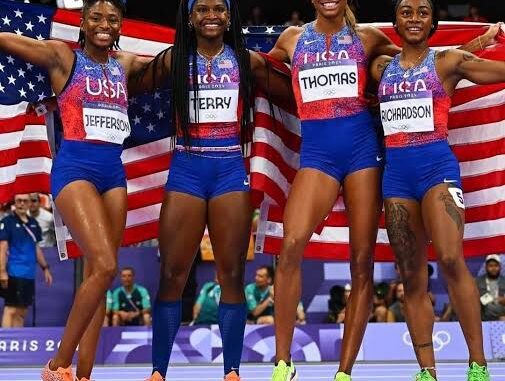
Olympic champions Melissa Jefferson-Wooden and Sha’Carri Richardson delivered a statement performance on the track, powering their team to a blistering, world-leading time in the women’s 4x100m relay. In a race that combined raw speed, flawless baton exchanges, and championship composure, the quartet reminded the athletics world why the United States remains a dominant force in sprint relays.
From the opening leg, the intent was clear. Jefferson-Wooden exploded out of the blocks with a sharp start, immediately putting her team in contention. Known for her smooth acceleration and strong top-end speed, she maintained composure under pressure, handing off the baton cleanly to the second leg runner. That first exchange set the tone for what would become a near-perfect relay display.
The spotlight, however, inevitably turned to Richardson, whose presence electrifies any race she enters. Running the anchor leg, Richardson received the baton with a slight advantage but still had work to do against a strong field. What followed was a showcase of her trademark flair and finishing power. With her upright running style and explosive stride, she surged away from challengers in the final meters, crossing the line with authority and sealing a world-leading mark that sent a message ahead of the major championships season.
This performance was not just about individual brilliance but about collective execution. Relay races are often won and lost in the exchanges, and this team demonstrated exceptional chemistry. Each baton pass was crisp, well-timed, and executed within the acceleration zones, minimizing any loss of momentum. That level of precision is a hallmark of well-drilled squads and suggests that the team has spent significant time refining their technique.
For Jefferson-Wooden, the race further cements her growing reputation as one of the most reliable sprinters in relay setups. Her ability to handle the pressure of the opening leg and deliver a strong start is invaluable. Meanwhile, Richardson continues to thrive in high-stakes moments, embracing her role as both a leader and a finisher. Her confidence and competitive edge often provide the psychological boost needed to close out tight races.
Beyond the immediate result, the world-leading time carries broader implications. It positions the team as early favorites heading into global competitions, where relay medals are often fiercely contested. Nations like Jamaica and Great Britain will undoubtedly be studying this performance closely, looking for any opportunity to challenge the American quartet.
Equally significant is the timing of the run. Achieving a world-leading mark early in the season indicates that the athletes are in excellent form and building momentum. It also sets a benchmark that other teams must now chase, adding an extra layer of pressure on their rivals.
The race also highlighted the depth of talent within U.S. sprinting. While Jefferson-Wooden and Richardson drew much of the attention, the contributions of their teammates were equally critical. Relay success depends on all four runners delivering, and this performance underscored the strength and cohesion of the entire squad.
As the season progresses, expectations will only grow. Fans and analysts alike will be eager to see whether this team can maintain their form and translate early-season dominance into championship gold. If this world-leading run is any indication, Jefferson-Wooden, Richardson, and their teammates are not just aiming to win—they are aiming to set the standard.
Be the first to comment