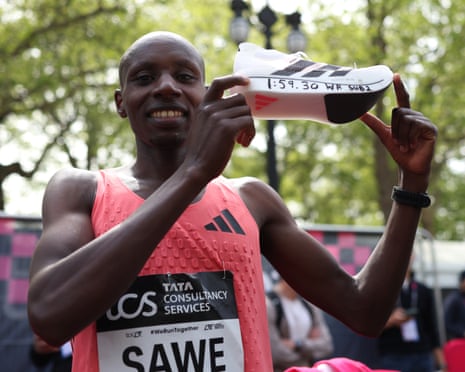
In a sport where limits are constantly tested but rarely shattered, Sabastian Sawe has carved out a moment that will be remembered for generations. Completing his first-ever marathon in under two hours is not just a personal milestone—it is a feat that challenges long-held beliefs about human endurance, preparation, and mental strength.
For decades, the two-hour marathon barrier stood as the ultimate benchmark in long-distance running. While legends like Eliud Kipchoge famously dipped under the mark in a controlled setting during the INEOS 1:59 Challenge, doing so in a debut marathon—without the same level of pacing assistance or experimental conditions—was considered nearly impossible. Yet Sawe managed to defy those expectations.
His journey to this historic performance was anything but accidental. Sawe built his reputation on the track and in road races, displaying a rare blend of speed and endurance. Transitioning to the marathon requires more than just talent; it demands strategic pacing, nutritional discipline, and an intimate understanding of one’s physical limits. Many elite runners take years to master the distance, often using their debut marathon as a learning experience rather than a record-breaking attempt.
What set Sawe apart was his fearless approach. From the start, he ran with intent, refusing to be conservative. His pacing was aggressive yet controlled, a delicate balance that only the most confident athletes can sustain. By maintaining a consistent rhythm and avoiding dramatic slowdowns, he positioned himself not just to finish strong, but to rewrite history.
Equally crucial was his preparation. Training at high altitude in Kenya, Sawe benefited from an environment that naturally enhances endurance. His regimen likely included long runs exceeding 30 kilometers, speed workouts to sharpen his finishing kick, and meticulous recovery routines. Behind the scenes, a team of coaches, nutritionists, and physiotherapists would have worked tirelessly to ensure that every detail—from hydration strategies to race-day fueling—was optimized.
However, the physical aspect tells only part of the story. Breaking such a barrier demands extraordinary mental resilience. The marathon is often described as a battle of the mind as much as the body, and Sawe demonstrated remarkable composure throughout. As fatigue set in during the later stages, where many runners struggle to maintain pace, he remained focused, pushing through discomfort with unwavering determination.
His achievement also reflects a broader trend in distance running. Advances in training methods, footwear technology, and sports science have pushed the boundaries of what athletes can achieve. Yet even within this context, Sawe’s accomplishment stands out because it came in his first attempt at the distance—a stage where uncertainty typically outweighs ambition.
The impact of this performance extends beyond personal glory. It inspires a new generation of runners to think bigger and aim higher. Young athletes watching Sawe’s run will see that barriers are meant to be broken, not respected. His success also raises the bar for elite marathoners, setting a new standard for what is possible in a debut race.
In the end, Sabastian Sawe’s sub-two-hour marathon debut is more than a statistic—it is a statement. It reminds the world that in athletics, as in life, the impossible is often just a limit waiting to be redefined.
Be the first to comment