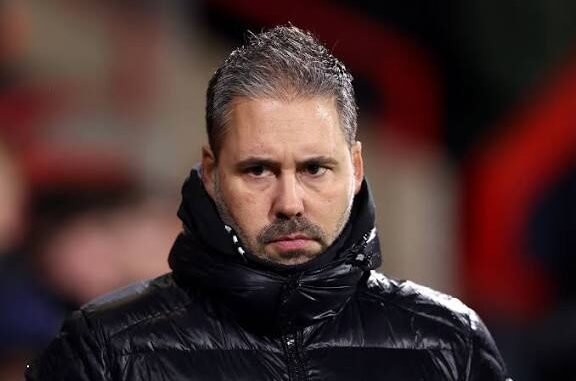
Analysis of Marti Cifuentes’ departure from the King Power Stadium, looking at where it went wrong for the Spaniard and how he was hamstrung by mistakes made above him
Marti Cifuentes during Leicester City’s 1-1 draw with Wrexham
Marti Cifuentes’ departure from Leicester City may have been warranted, but he’s a fall guy nonetheless.
The Spaniard lasted just six months in charge at the King Power Stadium, winning just 10 of his 29 league matches at the helm.
There’s a pretty substantial list of why Cifuentes’ exit feels justified and it’s not just that City have the lowest tally of points they’ve had at this stage of a season since the 2007-08 campaign in which the club were relegated to League One.
Saturday’s dreadful showing against Oxford was far from an isolated incident. Performances have been poor throughout the season.
Even in the opening months, when City lost just one of their first 10 Championship matches, the results were far better than the displays often deserved.
At Charlton in August, City were pummelled by the Addicks, but Jakub Stolarczyk’s saves, Charlton’s poor finishing at set-pieces and a wonderstrike from Abdul Fatawu earned them an unmerited three points.
This was a theme of Cifuentes’ reign. Only a few of the wins felt like they were earned through good team performances, with individual quality from the likes of Fatawu and Jordan James clinching three points on many other occasions.
There was an alarming inconsistency. City could play well in one half and then fall apart the next.
If they could have regularly performed as well as they did in the first period at Coventry just over a week ago, they’d be flying high in the table. But they couldn’t even extend that display to the second 45 minutes, never mind to the next game.
Cifuentes would often say that the team were emotionally impacted by moments in games and so would have dips in confidence. But there’s only so long a manager can say that before questions are asked as to why he has not been able to fix it.
The defensive record has been atrocious too. It’s now 23 games without a clean sheet in the Championship. That’s half a season. The next longest run in the division is eight matches.
Plus, there were games where they simply fell apart. Three times across November and December did they go in at the break at least 3-0 down. At QPR, it was 4-0, worse than any of the matches during last season’s miserable campaign.
And his tenure finished with an insipid loss to Oxford in which City looked clueless as to how to use their 77 per cent possession to create chances, something he was supposed to have coached into the team.
The atmosphere reached a new level of toxicity for the season and with the chairman witnessing it first hand, it was always going to put Cifuentes in trouble, no matter his defiance.
But despite all of the faults listed above, Cifuentes was still unfortunate. There will be supporters who believe he managed the team poorly and yet still have sympathy for him.
Marti Cifuentes during Leicester City’s 1-1 draw with Middlesbrough
Marti Cifuentes during Leicester City’s 1-1 draw with Middlesbrough(Image: Plumb Images/Leicester City FC via
Because no matter the mistakes he made, nor the problems he was unable to fix, he was still hamstrung by the errors and disorganisation of those above him.
For a start, he was appointed midway through pre-season because City had to wait to sack Ruud van Nistelrooy so that his pay-off would be part of a different financial year and would not cause further problems around Profit and Sustainability Rules.
Then, Cifuentes inherited a squad in which many of the players did not want to be present.
It could be argued that Enzo Maresca was in the same boat two years ago and yet he won those players around. However, there was a novelty to City’s Championship campaign then. It felt like a gap year before they were back in the Premier League where they wanted to be.
Coming into this season, that novelty had worn off. It no longer felt like City were destined to go straight back up and that they could enjoy a season of plundering goals past teams with far inferior wage bills. Cifuentes did not have a squad that was motivated to the same levels it had been previously.
As Cifuentes described it, there was a “rebuilding process” to be done with the squad. And there were games, including his final fixture in charge, where nine of the 20-man matchday line-up were academy graduates.
His use of youth players frustrated at times. While it feels like he’s introduced Louis Page well, he threw Bade Aluko in the deep end at Southampton having failed to give him time to adjust with substitute appearances in the previous weeks. That did not feel like good management.
Fans have wanted Cifuentes to be bolder in his selection of academy players, but the Spaniard was concerned by the toxic atmosphere and did not want to potentially damage these young players’ futures.
He spoke a few days ago, in his pre-match press conference for the Oxford fixture, that he was reluctant to expose young players to the kind of treatment Luke Thomas had had, even as a fellow homegrown player, where he was booed onto the pitch by his own fans.
In any case, there were limited ways in which Cifuentes could rebuild the squad. Because the investment simply wasn’t there.
Over the two windows for which he was in charge, City signed three loan players and two free agent goalkeepers. Not a single penny was spent on transfer fees.
Marti Cifuentes celebrates with Jordan James after Leicester City’s win at Norwich
Marti Cifuentes celebrates with Jordan James after Leicester City’s win at Norwich(Image: Plumb Images/Leicester City FC via Getty Images)
It is telling that all of the 16 players used by Cifuentes in his final game in charge had been at the club longer than he had.
This is a squad that desperately needs a refresh after two relegations in three seasons, and yet because of the poor financial management of those in charge of the club, Cifuentes was unable to make signings and was left to work with a squad that many supporters had negative opinions of.
Because there were not enough arrivals and not enough of a refresh in the summer, Cifuentes had to turn to the wantaway players like Harry Winks and Wout Faes. He eventually changed his mind again, pushing both to the side.
He knew what he was walking into, but it doesn’t change that Cifuentes was also a victim of the mistakes that have been made by the hierarchy over a number of years.
His life was made more difficult because there is a fanbase that has lost its love for the club because of how it has been mismanaged.
Cifuentes is far from the sole person to blame for the worsening atmosphere at the King Power Stadium, but he was the one to get his players to cope with it.
A club parts company with a manager because they believe they’re underperforming and that a new man can do a better job.
But because of how the club has been run and because of the restrictions that a new manager faces, there’s no guarantee that Cifuentes’ successor will have the club surging up the table.
There’s also no guarantee that the club will find the right man. They’ve made good appointments before, but that’s the last three in a row that have been unable to deliver what was asked of them.
On reflection, Cifuentes’ tenure will be seen as a failure. He is responsible and accountable for that.
Article continues below
But neither was he really set up to succeed. And those who appointed him and handed him the difficult task have not been held accountable in the same way.
Be the first to comment