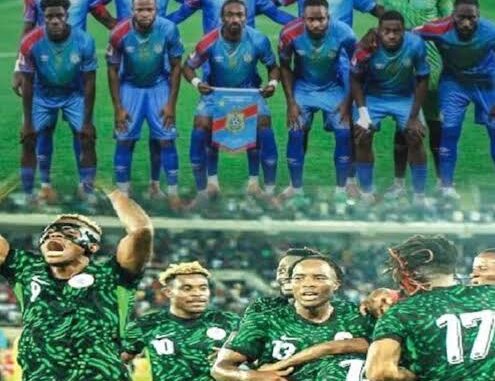
Nigeria’s hopes of featuring at the 2026 FIFA World Cup have been given an unexpected lifeline after the Nigeria Football Federation (NFF) lodged a formal complaint with football’s global governing body, FIFA, over the eligibility of players fielded by the Democratic Republic of Congo (DR Congo) during their decisive African qualifying play-off.
The Super Eagles’ bid to reach the global showpiece in the United States, Canada, and Mexico appeared to be firmly over after a dramatic penalty shoot-out loss to DR Congo in November 2025, a result that eliminated Nigeria from automatic progression and seemed to extinguish its World Cup aspirations for a second consecutive edition.
However, that narrative shifted sharply in recent days. The NFF submitted a detailed protest to FIFA’s Disciplinary Committee alleging that between six and nine DR Congo players who featured in the play-off encounter may not have met the necessary eligibility criteria under both FIFA and DR Congo domestic law.
At the heart of Nigeria’s complaint is a dispute over nationality and dual citizenship. DR Congo’s constitution does not generally permit dual nationality, yet many of the contested players are reported to hold European passports, including French and Dutch citizenships. Although FIFA initially cleared these players based on the presentation of valid DR Congo passports — meeting FIFA’s own nationality requirements — the Nigerian federation argues that this clearance was achieved on the basis of misleading documentation that failed to reflect compliance with DR Congo’s domestic legal framework.
NFF General Secretary Dr. Mohammed Sanusi has publicly stated that FIFA was “deceived” into approving the players, asserting that DR Congo’s laws require renunciation of prior citizenships before a player can acquire Congolese nationality and be eligible for international competition. The NFF argues that this process was not properly completed, and that the consequence should be the reversal of the result and Nigeria’s reinstatement into the qualifying pathway.
The potential ramifications of this appeal are enormous. If FIFA’s investigation finds merit in Nigeria’s claims, DR Congo could be sanctioned or even disqualified, paving the way for Nigeria — or another African nation — to take their place in the intercontinental play-offs scheduled for March 2026, where teams from around the world will compete for the final places in the expanded 48-team tournament.
DR Congo, for its part, has rejected the allegations, with the Congolese Football Federation (FECOFA) taking to social media to dismiss Nigeria’s challenge as a “backdoor” attempt to overturn the on-pitch result. In a strongly worded response, FECOFA urged that victories and qualifications should be decided on the field, not in legal corridors, and accused the Nigerian federation of being “bad losers.”
Beyond the immediate contest, this dispute highlights broader tensions in international football regarding nationality, citizenship laws, and FIFA’s regulatory framework. While FIFA’s eligibility rules have clear criteria — typically centered on holding a passport for the nation represented and meeting conditions around prior international appearances — the interaction with domestic laws that restrict dual nationality has thrown up a complex legal and sporting dilemma.
For Nigeria’s football supporters, the development has sparked cautious optimism. The Super Eagles have endured a difficult qualification cycle, having already missed the 2022 World Cup in Qatar and looking set to miss out on 2026 before this latest turn of events. A successful appeal could not only reignite national hopes of returning to football’s biggest stage, but also restore faith in procedural fairness and the importance of due process in international sport.
As the world awaits FIFA’s ruling, Nigeria’s World Cup dream hangs in the balance — not on a pitch in Rabat or Mexico, but in the legal and administrative arenas where football’s rules are interpreted and enforced
If you’d like, I can also tailor this into a more emotional piece (for social media or personal blog) or a formal news article.
Be the first to comment