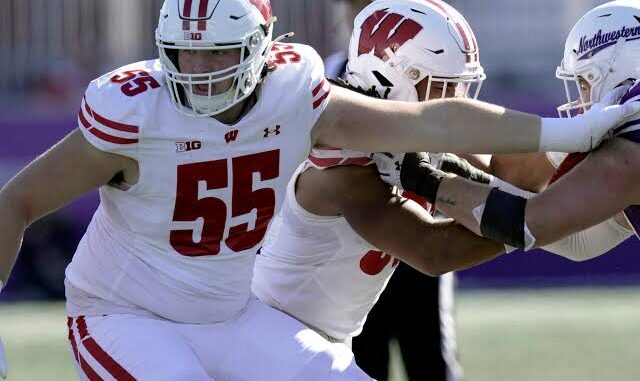
For most offensive linemen, development is measured in quiet progress—extra reps in the weight room, improved footwork, sharper recognition. For Wisconsin tackle Kevin Heywood, however, the journey back to form has been anything but routine. After suffering a torn ACL that threatened to derail his momentum, Heywood has returned to the field with renewed purpose, quickly reestablishing himself as a key figure for the Wisconsin Badgers.
ACL injuries are among the most challenging setbacks in football, particularly for linemen whose game depends on stability, leverage, and explosiveness. The recovery process is long and mentally demanding, requiring patience as much as physical resilience. For Heywood, the months following surgery were filled with grueling rehab sessions and incremental milestones—learning to trust his body again, rebuilding strength, and regaining confidence in his movement.
Yet, if there were doubts about how he would respond, Heywood has answered them emphatically during Wisconsin’s spring practices. Coaches and teammates have noted his improved conditioning and sharper technique, signs not just of recovery, but of growth. Rather than simply returning to his previous level, he appears to have elevated his game, using the injury as motivation to refine every aspect of his performance.
His presence is especially important for a Wisconsin program that has long prided itself on physical, disciplined offensive line play. The Badgers’ identity has been built on controlling the line of scrimmage, and having a reliable tackle like Heywood is central to that philosophy. His size and strength allow him to anchor effectively in pass protection, while his mobility enables him to contribute in the run game—an essential trait in Wisconsin’s system.
Beyond the physical tools, Heywood’s comeback has also had a noticeable impact on team morale. Injuries can isolate players, but his determination and work ethic have made him a source of inspiration within the locker room. Younger players, in particular, have taken note of how he approached the rehabilitation process, turning a setback into an opportunity for growth.
Wisconsin’s coaching staff has been careful in managing his return, ensuring that he is fully prepared for the demands of the upcoming season. While spring practice offers a controlled environment, the true test will come when the intensity ramps up in live competition. Still, early indications suggest that Heywood is more than ready to meet that challenge.
His story also reflects a broader trend in modern college football, where advancements in sports medicine and rehabilitation have made it possible for athletes to come back stronger after serious injuries. What once might have been a career-altering setback is now, with the right approach, a hurdle that can be overcome—and even serve as a catalyst for improvement.
As the Badgers look ahead, Heywood’s return could prove pivotal. A stable offensive line not only protects the quarterback but also establishes the foundation for a successful offense. If he continues on his current trajectory, Heywood will not just be a contributor—he could emerge as one of the anchors of Wisconsin’s line.
In the end, his comeback is about more than football. It is a testament to resilience, discipline, and the ability to respond to adversity with determination. For Kevin Heywood, the road back from an ACL tear has not just restored his career—it may have defined it.
Be the first to comment