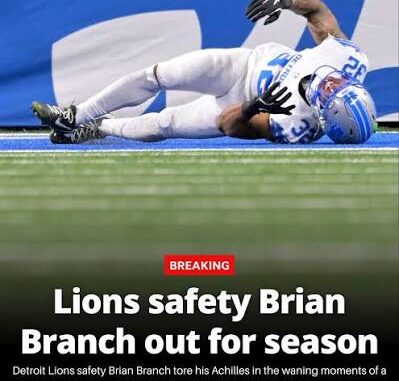
The Detroit Lions’ campaign took a harsh blow this week after it was confirmed that starting safety Brian Branch suffered a torn Achilles tendon, a devastating injury that will sideline him for the remainder of the 2025 season.
The injury occurred late in the Lions’ 44–30 victory over the Dallas Cowboys on Thursday night. Branch had been battling through smaller ankle and toe issues in recent weeks, but he stayed in the game — only to suffer the catastrophic tendon tear in the fourth quarter while defending a pass in the end zone. He limped off under his own power, then was carted to the locker room and later spotted on crutches and wearing a walking boot. The following day, imaging confirmed the worst: a torn Achilles.
For Detroit, the timing couldn’t be worse. Branch, who was drafted in the second round in 2023 out of Alabama, had blossomed into one of the team’s most reliable defensive playmakers. This season alone, he started all 12 games he played and totaled 75 tackles, 2.5 sacks, nine passes defensed, a forced fumble, and a fumble recovery. He had been one of the few bright spots on a defense riddled with injuries.
Already without starting safety Kerby Joseph — out since October with a knee injury — and cornerback Terrion Arnold, who recently underwent season-ending shoulder surgery, the Lions now face a critical depth crisis in their defensive backfield.
Now, the burden falls on veteran depth players such as Avonte Maddox and Daniel Thomas, who were pressed into duty late against Dallas, to carry the secondary — at least until the team can bring up reinforcements from the practice squad. Some names being floated as potential mid-season pickups (though nothing is official yet) include veteran safeties like Justin Simmons and Vonn Bell.
The medical outlook for an Achilles tear is grim — not only is it season-ending, but it typically requires surgery, months of rehabilitation, and a patient rebuilding of strength, flexibility, and confidence. That said, within the sports medicine community there remains cautious optimism: many athletes who suffer Achilles tears do eventually recover and return to high levels of performance, provided their rehab goes well.
For the Lions, losing Branch is more than just losing a single starter — it strikes at the core of a defense already stretched thin, and raises real questions about their ability to sustain momentum as they chase a playoff berth. Currently sitting at 8–5, Detroit remains alive in the postseason race, but the loss of a defensive anchor complicates their path forward.
Beyond just statistics, Branch’s absence hurts Detroit’s versatility. His athleticism, coverage range, and physical style made him a key piece in both pass defense and run support. The coaching staff now faces a challenge not only to fill the gap at safety, but to rework defensive schemes around a suddenly thinner secondary — likely leaning more heavily on zone coverage, simpler assignments, and perhaps more safety help over the top.
In short, what initially looked like a triumphant Thursday night for Detroit — a strong win over a divisional rival — has now turned into a major alarm bell. The Lions can celebrate the victory, but they must quickly reckon with a very real problem: salvaging a playoff push without one of their best defensive weapons. Time will tell whether the backups and potential roster changes will be enough to steady a ship now bruised and vulnerable.
Be the first to comment