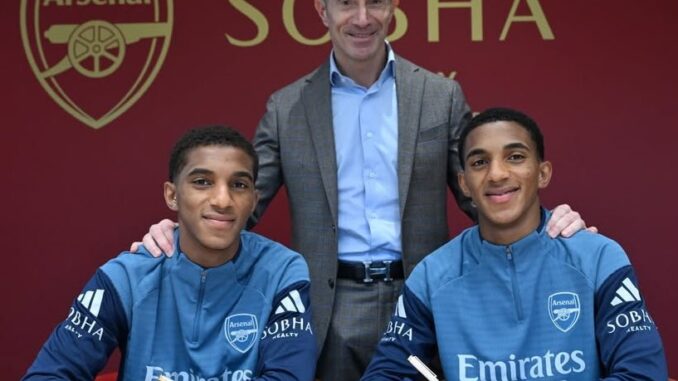
Arsenal’s announcement of securing Ecuadorian twins Holger and Edwin Quintero from Independiente del Valle on long-term deals set to begin in 2027 has triggered a mixture of excitement and curiosity within the fanbase. Excitement because the Quintero brothers are regarded as two of the most promising young prospects in South America. Curiosity because fans can’t help but look back at the previous sporting structure and wonder how opportunities like this seemed to pass Arsenal by in recent years.
For many supporters, this type of proactive, forward-thinking business highlights a glaring contrast to the Edu Gaspar era. While Edu deserves credit for helping rebuild the squad post-Emery—bringing in the likes of Gabriel, Partey, Ødegaard and key academy reinforcements—there were lingering concerns about Arsenal’s reach in the global talent market. Other elite clubs consistently tapped into South America, finding gems before the rest of Europe took notice. Meanwhile, Arsenal often seemed reactive rather than pioneering.
That’s exactly where the frustration stems from. When you see Independiente del Valle, a youth-development powerhouse in Ecuador, producing elite young players year after year, the natural question becomes: why weren’t Arsenal in that market sooner? The fact that these twins—both technically gifted, tactically intelligent and already showing signs of high ceilings—were identified early enough to be secured for 2027 only reinforces how modern scouting should work. It’s the kind of smart, low-cost, high-upside investment that Arsenal fans have been demanding for years.
Instead, as fans jokingly (and sometimes painfully) recall, Edu was reportedly spending valuable time trying to convince Raheem Sterling to join Arsenal on loan. That alone became a symbol for the lack of strategic clarity. While other clubs were scouring Colombia, Brazil, Ecuador, and Uruguay for long-term superstars, Arsenal were being linked with short-term Premier League cast-offs—moves that felt more like firefighting than building for the future. It wasn’t just about Sterling; it was about the wider pattern of Arsenal being late in South American recruitment despite the region’s obvious pipeline of elite talent.
And that’s why supporters are so quick to say, half-jokingly but half-seriously: “God bless Andrea Berta for us, please.” What Berta represents—whether in reality or perception—is a new level of competence, aggressiveness, and vision in talent identification. Arsenal fans have craved that kind of direction: a sporting structure that doesn’t simply copy Europe’s scouting trends but gets ahead of them.
The Quintero twins’ arrival symbolises exactly that shift. They may not be ready-made stars today, but landing them years before their breakout sends a message. It tells the world that Arsenal intend to operate like a modern superclub—one with a clear plan, a global scouting footprint, and leadership willing to take calculated risks.
Of course, the twins will need time, development, and the right environment to fulfil their potential. But their signings alone reflect a cultural shift Arsenal fans have been yearning for. This is the kind of long-term thinking capable of shaping the club’s next decade, not just its next transfer window.
If this is the new Arsenal, then the future looks far more exciting than the past few years ever suggested.
Be the first to comment