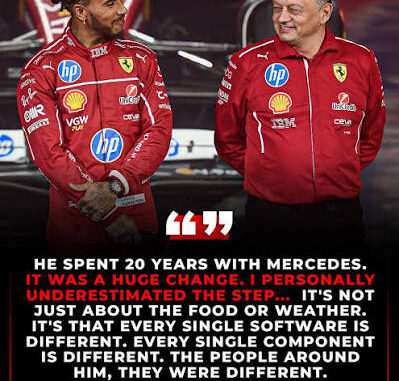
Fred Vasseur has openly acknowledged that he underestimated the scale of the challenge Lewis Hamilton would face in adapting quickly to life at Ferrari, a candid admission that highlights both the complexity of modern Formula 1 and the magnitude of Hamilton’s move. The seven-time world champion’s switch from Mercedes to Ferrari is one of the most seismic driver transfers in the sport’s history, but Vasseur’s comments serve as a reminder that even generational talent is not immune to transition difficulties.
Hamilton’s arrival at Ferrari was always going to be emotionally charged and technically demanding. After more than a decade at Mercedes, where he became synonymous with the team’s culture, systems, and working methods, stepping into Ferrari’s unique environment represents a complete reset. Vasseur, who has worked with Hamilton before in junior categories, admitted that he expected the Briton’s experience and adaptability to smooth the process faster than it has so far. However, Formula 1 in 2025 is far removed from the junior formulas where raw speed can immediately compensate for unfamiliarity.
One of the main challenges Hamilton faces is Ferrari’s operational DNA. Ferrari’s car philosophy, engineering language, and even race-weekend processes differ significantly from Mercedes’. From how data is interpreted to how feedback is translated into setup changes, Hamilton must recalibrate instincts honed over years. Vasseur acknowledged that these subtleties take time to master, even for a driver of Hamilton’s calibre, and that expecting instant perfection may have been unrealistic.
Another factor is the sheer weight of expectation that comes with driving for Ferrari. Every lap, radio message, and result is scrutinized globally, often more intensely than at any other team. For Hamilton, this pressure is compounded by the narrative surrounding his legacy: fans and pundits alike are eager to see whether he can win an eighth world title in red. Vasseur admitted that the psychological adjustment — balancing Ferrari’s passion with performance consistency — is something that cannot be rushed.
Ferrari’s current competitiveness has also played a role. While the team has made progress, they are still refining their package in an era of razor-thin margins. Hamilton is learning a car that is evolving race by race, making adaptation more complex. Vasseur emphasized that adaptation is not just about the driver fitting the car, but also about the team learning how to extract the best from the driver — a two-way process that takes time.
Importantly, Vasseur’s admission does not signal concern or regret. Instead, it reflects a realistic understanding of Formula 1’s modern demands. He stressed that Hamilton’s work ethic, feedback quality, and commitment remain exceptional, and that the foundations being built now will pay dividends later. Ferrari, Vasseur insists, is playing the long game.
Hamilton himself has remained measured, acknowledging that greatness is not defined by instant success but by perseverance and growth. His willingness to embrace the challenge underscores why Ferrari pursued him in the first place. Vasseur’s honesty, meanwhile, reinforces trust within the team and sets a healthier narrative for fans and media.
Ultimately, underestimating the difficulty of Hamilton’s adaptation may be understandable — after all, drivers of his stature rarely struggle publicly. But Ferrari’s leadership now recognizes that true success will come not from impatience, but from allowing one of the sport’s greatest drivers the time and support needed to truly become Ferrari’s Lewis Hamilton.
Be the first to comment