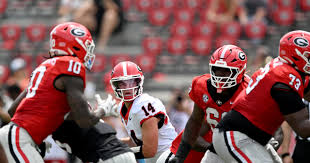
Concerns are beginning to surface about the future of the Georgia Bulldogs’ passing attack, with one ESPN analyst suggesting the unit could be “even less threatening” in 2026. It’s a bold claim, especially considering Georgia’s sustained success in recent years, but it reflects a growing conversation about how the program’s offensive identity is evolving—and whether it could face limitations in the near future.
Under head coach Kirby Smart, Georgia has built a powerhouse rooted in physical dominance, elite defense, and a methodical offensive approach. While that formula has delivered championships and consistent playoff contention, critics argue that the passing game has not always been the focal point. Even during their most successful seasons, Georgia has leaned heavily on a balanced—or at times run-first—attack rather than a high-octane aerial assault.
The ESPN analyst’s concern centers on personnel turnover and system continuity. With key quarterbacks and wide receivers cycling through the program, maintaining a consistently explosive passing game becomes more challenging. Development remains strong in Athens, but replacing experienced playmakers with younger, less proven talent can temporarily reduce efficiency and explosiveness through the air.
Another factor is the offensive philosophy itself. Georgia’s scheme prioritizes control, minimizing mistakes, and winning in the trenches. While effective, this approach can limit the volume and aggressiveness of downfield passing. Compared to programs that embrace pass-heavy systems, Georgia’s offense may appear more conservative, especially in big games where risks are carefully managed.
The departure of top-tier receiving threats has also fueled the narrative. Elite wide receivers who can stretch defenses vertically or create separation consistently are crucial for a dynamic passing attack. If Georgia’s recruiting or development at that position dips—even slightly—it could reinforce the idea that their passing game lacks the same bite as some of their national rivals.
At quarterback, uncertainty can amplify these concerns. Whether it’s a young starter stepping into a bigger role or a transfer still adjusting to the system, timing and chemistry with receivers take time to develop. Without that cohesion, even talented quarterbacks can struggle to produce a threatening aerial presence.
However, it’s important to balance criticism with context. Georgia’s offensive structure is designed to complement its defense, not necessarily to dominate statistically through the air. Efficiency often matters more than volume. In many cases, Georgia doesn’t need to throw for 350 yards to win comfortably. Their ability to control tempo, sustain drives, and capitalize on key passing moments has proven highly effective.
Additionally, the program’s recruiting strength should not be overlooked. Georgia consistently attracts elite talent at every position, including quarterback and wide receiver. Even if there is a temporary dip in production, the pipeline of incoming players suggests that any perceived weakness may be short-lived.
There’s also the possibility that the criticism itself becomes motivation. Programs like Georgia are known for internal development and adaptation. If the coaching staff identifies limitations in the passing game, adjustments in play-calling, scheme, or personnel usage could quickly change the narrative.
Ultimately, the idea that Georgia’s passing offense could be “even less threatening” in 2026 is more of a projection than a certainty. It highlights legitimate questions about roster turnover and offensive philosophy, but it also underestimates the program’s ability to evolve. As always in college football, performance on the field will determine whether these concerns hold weight or fade into the background of another successful season.
Be the first to comment