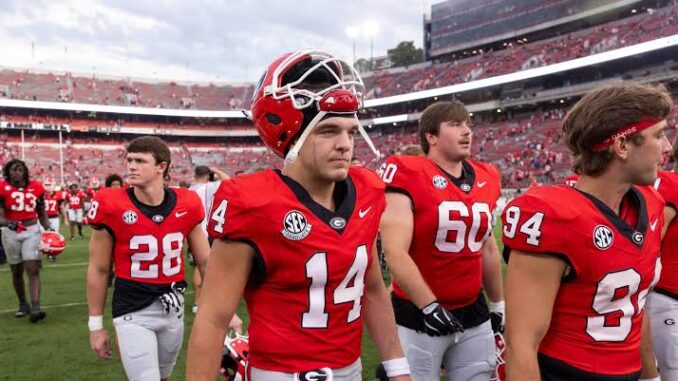
Georgia continues to prove that elite college football programs can thrive even as the NIL era reshapes the financial landscape, with the Bulldogs reportedly pushing past $300 million in fundraising despite growing concerns around donor fatigue. At a time when many programs are struggling to balance traditional athletic donations with increasing NIL demands, Georgia appears to be bucking the trend and reinforcing its status as one of college athletics’ financial powerhouses.
The University of Georgia recently surpassed the $300 million mark in private fundraising for the first time in school history, recording more than $300.4 million in support from over 72,000 donors. That figure reflects the broad strength of the Bulldogs’ donor base and underscores how Georgia has managed to maintain momentum even as fans and boosters across the country face growing pressure to contribute to NIL collectives in addition to traditional fundraising efforts.
Donor fatigue has become one of the most discussed issues in college sports over the past two years. Across the nation, boosters who once gave primarily toward facilities, scholarships, and athletic department projects are now being asked to contribute directly or indirectly toward player compensation through NIL-backed initiatives. For many schools, that has created tension as donors question how much more they can realistically be expected to give.
Yet Georgia’s fundraising success suggests the Bulldogs have found a way to navigate that challenge more effectively than most.
Part of Georgia’s advantage lies in the sheer size and passion of its support network. The Bulldogs boast one of the largest and most engaged fan bases in the SEC, and that loyalty continues to translate into financial backing. Rather than relying solely on a handful of mega-boosters, Georgia benefits from a broad donor pool that includes alumni, parents, corporate partners, and longtime supporters. That diversified support system helps reduce the burden on individual donors while sustaining major fundraising totals.
Another factor is Georgia’s continued excellence on the field. Winning remains the strongest motivator in college athletics fundraising, and Kirby Smart’s program has given donors every reason to keep investing. The Bulldogs remain firmly in the national championship conversation each season, and their sustained success has helped maintain enthusiasm even as NIL changes the economics of the sport.
Georgia has also attempted to position itself strategically within the NIL market. Rather than trying to simply outspend every rival for recruits, the Bulldogs have emphasized player development, NFL preparation, and long-term brand building alongside NIL opportunities. That approach has allowed Georgia to remain highly competitive in recruiting without appearing entirely dependent on massive NIL promises.
Importantly, the fundraising figures are not solely football-related. Georgia’s record-setting donor support also benefits academic initiatives, scholarships, faculty development, and the university’s new School of Medicine. That broader institutional mission likely helps sustain enthusiasm among donors who may be less interested in pure NIL spending but still want to support the university as a whole.
Still, Georgia’s ability to power through donor fatigue does not mean the issue has disappeared. Even among elite programs, concerns remain about the long-term sustainability of asking boosters to continually fund player compensation while also maintaining traditional giving levels. Many across college athletics believe revenue-sharing models or further NCAA reform will eventually be needed to ease the burden on donors.
For now, however, Georgia appears better positioned than most. The Bulldogs are showing that while donor fatigue is real, winning, strategic fundraising, and institutional strength can still keep the money flowing.
Be the first to comment