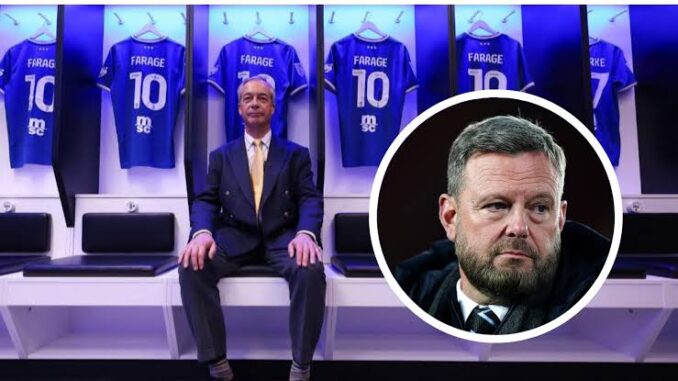
The chairman of Ipswich Town has issued a heartfelt apology to supporters following a wave of backlash triggered by the recent visit of Nigel Farage to the club. The controversy has sparked intense debate among fans, raising questions about the intersection of football, politics, and community values.
In a statement released shortly after the incident gained traction online, the Ipswich chair acknowledged the emotional impact the visit had on sections of the club’s fanbase. He admitted that allowing Farage to be hosted at the club, whether in an official or informal capacity, was a decision that had not been fully thought through in terms of its wider implications.
“I want to sincerely apologise to supporters who felt hurt or upset,” the statement read. “Ipswich Town has always prided itself on being an inclusive, community-driven club, and it was never our intention to create division or discomfort among our fans.”
The visit, which initially appeared to be low-profile, quickly became a talking point after images circulated on social media. Fans expressed a wide range of reactions, with some defending the chairman’s decision on the grounds of neutrality, while others argued that the presence of a politically polarising figure conflicted with the club’s values of unity and inclusivity.
For many supporters, football represents more than just the game—it is a shared cultural space where people from diverse backgrounds come together. As such, the involvement of high-profile political figures can be seen as disruptive, especially when those figures are associated with contentious viewpoints.
The Ipswich chair’s apology sought to address these concerns directly, emphasizing that the club does not endorse any political ideology or individual. He reiterated that Ipswich Town remains committed to fostering a welcoming environment for all fans, regardless of their personal beliefs.
“We understand that football clubs hold a special place in their communities,” he continued. “We must be mindful of that responsibility in every decision we make, and on this occasion, we fell short.”
The incident has also reignited a broader conversation within English football about how clubs navigate political associations. While football institutions often strive to remain apolitical, complete neutrality can be difficult to maintain, particularly in an era where public figures frequently intersect with sporting spaces.
Supporters’ groups have responded to the apology with cautious acceptance. Some have praised the chairman for addressing the issue promptly and taking responsibility, while others have called for clearer guidelines to prevent similar situations in the future. There is a growing sentiment that clubs must establish firmer boundaries when it comes to political engagement, particularly when it risks alienating their core supporters.
Despite the controversy, many fans are hopeful that the situation will serve as a learning moment for the club’s leadership. Ipswich Town has enjoyed a resurgence in recent years, both on and off the pitch, and maintaining a strong relationship with its supporters will be crucial moving forward.
Ultimately, the chairman’s apology represents an important step toward rebuilding trust. By acknowledging the mistake and reaffirming the club’s commitment to its community, Ipswich Town aims to move past the incident and refocus on what truly matters—football, unity, and the shared passion of its fans.
Be the first to comment