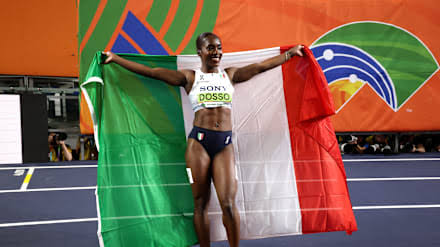
Italy’s sprint star Zaynab Dosso finally achieved her long-awaited breakthrough on the global stage, storming to gold in the women’s 60m at the World Athletics Indoor Championships Toruń 2026. After years of near misses and steady progression, Dosso delivered a composed and explosive performance when it mattered most, cementing her place among the world’s elite sprinters.
Heading into the championships in Toruń, Dosso was widely viewed as a serious contender, but not necessarily the outright favourite. The field featured some of the fastest women in the world, including Olympic champion Julien Alfred and a host of emerging talents. However, Dosso’s consistency throughout the indoor season suggested she was ready to take the next step.
That step came emphatically in the final. Bursting out of the blocks with precision and power, Dosso maintained her composure through the drive phase and held off a tightly packed field to cross the line in 7.00 seconds. The performance not only secured her the gold medal but also marked one of the fastest times of the season, underlining her elite status in the discipline.
Behind her, the competition was fierce. American sprinter Jacious Sears claimed silver, while Alfred had to settle for bronze after a closely fought finish. The margins were razor-thin, highlighting just how crucial Dosso’s execution was in securing victory.
What makes this triumph particularly significant is the journey that preceded it. Dosso had already experienced both ends of the podium at previous editions of the championships, taking bronze in 2024 and silver in 2025. That progression set the stage for what felt like an inevitable gold, yet the pressure of expectation can often derail even the most talented athletes. Instead, Dosso embraced the moment, completing a rare full set of World Indoor 60m medals.
Her victory is also historic for Italian athletics. By winning gold, Dosso became the first Italian woman to claim the world indoor 60m title, a landmark achievement that further elevates her profile within the sport. It represents not just personal success, but a broader milestone for sprinting in Italy.
Technically, the race showcased Dosso’s strengths. Her reaction time and acceleration phase were among the best in the field, allowing her to establish an early advantage. Over such a short distance, maintaining form under pressure is critical, and Dosso demonstrated remarkable control as challengers closed in during the final metres.
Beyond the medal itself, this victory could prove to be a defining moment in Dosso’s career. At 60 metres, the margins are minimal, but confidence plays a huge role. Having now converted her potential into a global title, she will likely approach future competitions with renewed belief and authority.
Looking ahead, attention will naturally turn to outdoor events, particularly the 100m, where Dosso has already shown impressive capability. Her indoor success in Toruń could serve as a springboard for even greater achievements on the global stage.
In the end, the story of the women’s 60m final at Toruń 2026 was one of persistence rewarded. After years of climbing the podium step by step, Zaynab Dosso finally reached the top—and did so in style.
Be the first to comment