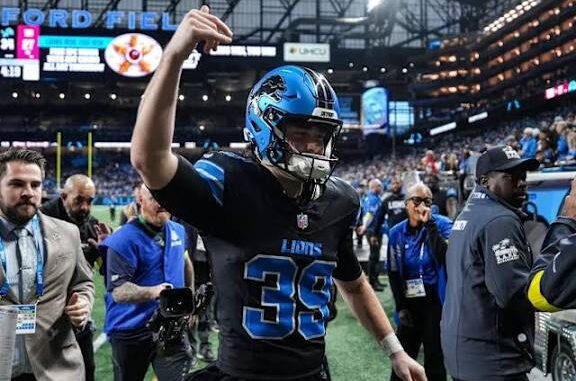
The Detroit Lions have reportedly taken a straightforward but important step in securing stability on special teams, tendering kicker Jake Bates an Exclusive Rights Free Agent (ERFA) offer. While the move may not generate the same headlines as a blockbuster trade or splashy free-agent signing, it signals the organization’s intent to maintain continuity in a crucial phase of the game.
Under NFL rules, an ERFA is a player with fewer than three accrued seasons whose contract has expired. If his team tenders him a one-year offer at the league minimum, he is not permitted to negotiate with other teams. In effect, the tender ensures that Bates will remain in Detroit for the 2026 season, provided he signs the deal. It is a cost-effective mechanism for teams to retain developing talent without entering bidding wars on the open market.
For the Lions, the decision reflects confidence in Bates’ leg and potential. After earning his opportunity and demonstrating composure in pressure situations, Bates showed enough consistency to convince the coaching staff that he is worth keeping in the fold. In a league where kicking struggles can derail otherwise promising campaigns, reliability at the position carries significant value.
Detroit’s front office has emphasized culture and competition in recent years, and special teams have been no exception. Head coach Dan Campbell has repeatedly stressed the importance of complementary football — offense, defense and special teams working in sync. By tendering Bates early in the offseason, the Lions eliminate uncertainty at kicker and allow the coaching staff to focus on refining other areas of the roster.
Financially, the ERFA tender is a low-risk move. The one-year contract typically comes at or near the league minimum salary for a player with Bates’ experience level. That gives Detroit flexibility to allocate cap space elsewhere, whether reinforcing depth along the offensive line, adding defensive playmakers, or preparing extensions for core contributors. Maintaining roster balance is critical for a team with postseason aspirations.
From Bates’ perspective, the tender represents both security and opportunity. While he does not have the leverage to test the open market, he does have another season to solidify his standing and potentially position himself for a longer-term contract down the line. Strong performance in 2026 could open the door to an extension or, at minimum, provide leverage when he becomes eligible for restricted or unrestricted free agency in future offseasons.
Special teams continuity often goes overlooked, but it can be the difference in tight divisional contests. In a competitive NFC landscape, every field goal attempt and kickoff placement matters. If Bates continues to develop accuracy and range, the Lions will benefit from having a steady option in high-pressure moments.
The move also underscores Detroit’s methodical roster-building approach. Rather than overreacting or cycling through options, the organization appears committed to rewarding internal development. By tendering Bates as an ERFA, the Lions maintain stability at kicker without sacrificing flexibility.
It may not be the flashiest transaction of the offseason, but it is a practical one. In a league defined by razor-thin margins, locking in a dependable specialist can quietly strengthen a contender’s foundation — and the Lions are clearly betting that Jake Bates can be part of that formula moving forward.
Be the first to comment