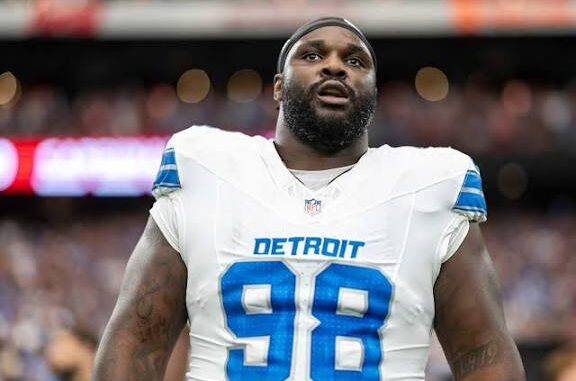
When the Detroit Lions signed DJ Reader, the expectation was clear: bring in a proven, space-eating defensive tackle who could solidify the run defense and elevate a young front seven. At his best, Reader does exactly that. He clogs lanes, commands double teams, and allows Detroit’s edge rushers and linebackers to play faster and freer. But as the 2026 offseason approaches, his future in Honolulu Blue feels anything but certain.
Reader has long been regarded as one of the NFL’s premier nose tackles. At roughly 6-foot-3 and over 330 pounds, he is built to anchor the interior. His value doesn’t always show up in flashy sack totals, but it’s evident in the way opposing rushing attacks struggle to find daylight up the middle. During stretches of the 2025 season, Detroit’s run defense looked far more disciplined and physical when Reader was on the field. His presence alone changed blocking schemes and forced offenses to adjust.
However, the murkiness surrounding Reader’s future stems from a combination of age, durability, and cap considerations. By the time the 2026 season kicks off, Reader will be on the wrong side of 30—a notable milestone for a player whose game relies heavily on strength and leverage in the trenches. Defensive tackles can age gracefully, but nose tackles who absorb constant double teams tend to accumulate wear and tear quickly.
Injuries have also been part of Reader’s recent story. While he has battled back admirably in the past, availability matters. The Lions have Super Bowl aspirations, and general manager Brad Holmes has consistently emphasized building a deep, sustainable roster. If Detroit believes Reader’s best years are behind him, they may hesitate to commit significant money to a new deal.
Financially, the Lions are approaching a crossroads. Extensions for cornerstone players and future cap planning will require careful maneuvering. Investing premium dollars in a veteran defensive tackle could limit flexibility elsewhere, especially as Detroit continues to build around its young core. The front office must weigh Reader’s immediate impact against the long-term vision of the roster.
On the other hand, letting Reader walk carries its own risk. Detroit’s defensive identity under Dan Campbell has been built on toughness and physicality. Reader embodies that mindset. Removing him from the equation could weaken the interior and place additional pressure on younger defensive linemen to step into a demanding role. Replacing a player of his caliber is easier said than done.
There is also the locker room factor. Reader’s professionalism and work ethic set a tone. For a team that has prided itself on culture, leadership cannot be dismissed as a minor detail. If the Lions believe his influence extends beyond the stat sheet, that could tilt the decision toward retaining him on a short-term, incentive-heavy deal.
Ultimately, Reader’s future in Detroit may come down to numbers—both on the field and on the salary cap spreadsheet. If he can continue to anchor the run defense at a high level and stay healthy, a modest extension makes sense. If decline or injuries creep in, the Lions may pivot to a younger, cheaper alternative.
For now, the situation remains unsettled. DJ Reader has proven his value when healthy, but the realities of age, durability, and team-building strategy have clouded the outlook. As 2026 free agency nears, the Lions face a delicate decision that could quietly shape the foundation of their defense for years to come.
Be the first to comment