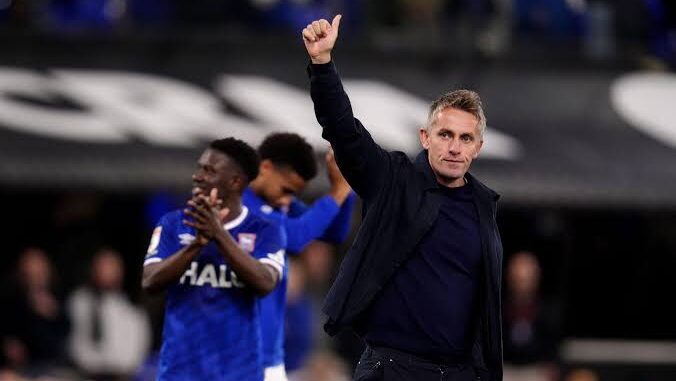
Ipswich Town’s remarkable rise under Kieran McKenna has shifted expectations from hopeful optimism to genuine belief, and as the 2025/26 campaign gathers momentum, the Tractor Boys are increasingly looking like a club destined for a Premier League return in 2026. Built on clarity, consistency, and a modern footballing identity, Ipswich are no longer punching above their weight — they are setting the standard.
At the heart of Ipswich’s success is McKenna’s tactical intelligence and calm authority. Since arriving at Portman Road, the former Manchester United coach has instilled a clear playing philosophy centred on controlled possession, intelligent pressing, and positional discipline. Ipswich are comfortable dominating the ball against deep blocks, yet equally capable of springing forward at speed when space opens up. That adaptability has been crucial in a Championship landscape defined by tactical variety and physical intensity.
Squad continuity has also played a vital role. Unlike many promotion hopefuls who rely on constant churn, Ipswich have kept the core of their group together, allowing chemistry and understanding to flourish. Players know their roles, automatisms are well-rehearsed, and performances rarely dip regardless of opposition. This stability has created a team that looks mentally robust — a trait that separates contenders from pretenders over a gruelling 46-game season.
Recruitment has been another decisive factor. Ipswich’s transfer strategy has prioritised profile over profile-raising signings, targeting players who fit McKenna’s system both technically and psychologically. The blend of energetic youth and Championship-proven experience has given the squad balance, while depth across key positions ensures injuries or suspensions do not derail momentum. Crucially, signings have enhanced competition rather than disrupted harmony.
Defensively, Ipswich have evolved into one of the division’s most reliable units. Their compact shape without the ball, combined with intelligent pressing triggers, limits high-quality chances conceded. Rather than retreating passively, Ipswich defend proactively, squeezing space and forcing errors in dangerous areas. That structure provides a platform for consistent results, especially in tight matches where fine margins decide outcomes.
Going forward, Ipswich possess multiple avenues of threat. Their attacking patterns are varied — overlapping full-backs, midfield runners arriving late in the box, and wide players capable of both creation and goals. This unpredictability makes them difficult to nullify, particularly against sides that attempt to match them man-for-man. Importantly, Ipswich are not reliant on one talisman; goals are shared across the squad, reducing pressure and increasing sustainability.
Mentality may ultimately be the defining factor behind Ipswich’s promotion push. The Tractor Boys play with composure, belief, and a visible hunger to improve. Setbacks are treated as learning opportunities rather than momentum-killers, and late-game scenarios often showcase their maturity. That psychological edge is often what separates automatic promotion sides from those stuck in the play-offs.
Beyond the pitch, the club’s leadership and long-term vision suggest Ipswich are building for more than just a fleeting promotion. Infrastructure investment, data-led decision-making, and alignment between ownership, management, and recruitment have created a stable environment primed for top-flight football. Promotion in 2026 would feel like the natural next step, not an overachievement.
All signs point toward Ipswich Town being on an upward trajectory that is both deliberate and sustainable. With McKenna’s guidance, a cohesive squad, and a club moving in unison, the Tractor Boys are not just dreaming of the Premier League — they are methodically marching toward it.
Be the first to comment